
Clorox Healthcare Bleach
$89.50 at Amazon
Check it on AmazonPrice as of Oct 24, 2026, 5:30 AM EDT
Details ↓
Four EPA-registered sprays for the bathroom after a dirty job, scored from their own EPA labels: how fast they kill and what they need from you.
As an Amazon Associate I earn from qualifying purchases.
Buy Clorox Healthcare Bleach Germicidal Cleaner for toilets and sewage messes: 1 minute for most germs, 3 for C. diff spores. Get EcoClean for no bleach, Clean-Up for 30-second kills on tile, or Seventh Generation for no-rinse kitchens.
Each is the genuine brand, new, in stock and sold by Amazon when we checked at 1:51 a.m. on Oct 22, 2026. Each bottle’s active ingredient matches its EPA registration, and each scored 7.0 or higher on our spec score.


Product prices and availability are accurate as of the date/time indicated and are subject to change. Any price and availability information displayed on Amazon.com at the time of purchase will apply to the purchase of this product.
Five checks from each spray’s EPA-accepted label and EPA’s own pathogen lists, equal weight. The rules and every input are in the method section near the end.
Clorox Healthcare wins because it’s the only one of the four on EPA’s list of products that kill C. diff spores, and its label spells out how to clean up fecal matter. It also kills most germs in 1 minute. EcoClean is the fastest on norovirus at 30 seconds, and Clean-Up is the fastest on bacteria at 30 seconds.
Seventh Generation is the slowest, at 10 minutes, but it’s the only one you don’t rinse off a food-contact surface, and its label needs no warning word.
What each spray kills and how fast, what the label asks of you, and where its listing and its label say different things.
Germicidal Cleaner spray, 6 bottles of 32 oz
Prices and availability are accurate as of the time shown and may change.
You clean up after toilet pulls, sewer backups and cleanouts, where feces and the germs in them land on tile, porcelain and floors.
You want a spray for a kitchen counter you won’t rinse. Seventh Generation is the only no-rinse pick here.
Clorox Healthcare Bleach Germicidal Cleaner is the spray I’d carry for sewage jobs, and I’ve used it. This is a case of six 32 oz trigger bottles, sold and shipped by Amazon when we checked. Its EPA registration is 56392-7, and the 0.65% sodium hypochlorite on the bottle matches EPA’s record.
It’s the top pick for one reason a plumber cares about. It’s the only spray here on EPA’s List K, the list of products proven against C. diff spores. Its C. diff directions are written around fecal matter, and EPA says a disinfectant doesn’t necessarily kill bacterial spores. The list gives it a 3-minute contact time.
For everything else it’s quick. The spray column of its label gives 1 minute for MRSA, staph and the other bacteria, and EPA’s norovirus list, List G, gives it 1 minute too. The pack says it kills over 60 pathogens.
The label tells you how to do a C. diff job, and it reads like a sewer-backup checklist. Wear gloves, a gown, a mask or eye protection. Clean the fecal matter off first with a cloth, mop or sponge soaked in the product, scrubbing until no soil shows.
Then spray from 6 to 8 in until the surface is wet and leave it wet for 3 minutes. Clean the restroom last, and don’t reuse a dirty cloth.
It’s still bleach. The label calls it a strong oxidizing agent and says mixing it with ammonia, acids, detergents, urine or feces in a way the label doesn’t direct can release gases that irritate eyes and lungs. That’s why the cleaning step comes first.
Its signal word is CAUTION, for moderate eye irritation, a step milder than Clean-Up’s WARNING. Food-contact surfaces need a rinse with drinking water afterward, and it isn’t for dishes, glassware or utensils.
My call: keep one bottle on the truck for toilets, floors and anything a backup touched.
CloroxPro Clorox EcoClean Disinfecting Cleaner spray, 32 oz
Prices and availability are accurate as of the time shown and may change.
You disinfect around matte black trim, finished vanities and stainless after a repair, and you’d rather not spray bleach in a customer’s home.
The mess came from a sewer backup. For C. diff spores, the label you want is Clorox Healthcare’s.
CloroxPro EcoClean Disinfecting Cleaner is the spray I’d use when bleach would be the wrong call, and I’ve used it. It’s one 32 oz trigger bottle, sold and shipped by Amazon when we checked. Its EPA registration is 67619-45, and the 0.4% L-lactic acid on the bottle matches EPA’s record.
It’s the fastest here on viruses. The label gives 30 seconds for the viruses it lists, and EPA’s norovirus list gives it 0.5 minutes, the shortest of the four. That scored a 10.
Bacteria take longer. The label’s disinfecting time for MRSA and staph is 2 minutes, which scored an 8. The pack sums it up as disinfects in 2 minutes, for norovirus, cold and flu viruses and MRSA.
It has a quicker setting for light work. Sprayed on a surface that isn’t for food, it sanitizes in 15 seconds, per its label. Sanitizing lowers bacteria; it isn’t a full disinfection, so for a toilet seat after a repair, give it the full 2 minutes.
This is the gentlest of the four to work with. The pack says it’s made without dyes, bleach, ammonia or alcohol, and that no gloves, goggles or PPE are required. The label’s signal word is CAUTION, for moderate eye irritation.
Its pack lists laminate, stainless steel and finished wood, which it defines as finished, painted or sealed. It carries EPA’s Design for the Environment and Safer Choice logos, with the line “Ingredients reviewed by the EPA.”
Two limits from the label. Visibly soiled areas must be cleaned before you spray, and food-contact surfaces get a rinse with drinking water. Don’t use it on eating utensils, glassware or cookware.
It isn’t on EPA’s C. diff spore list, so that check scored a 6.
My call: carry it for finished bathrooms and kitchens, and keep the bleach for the dirty jobs.
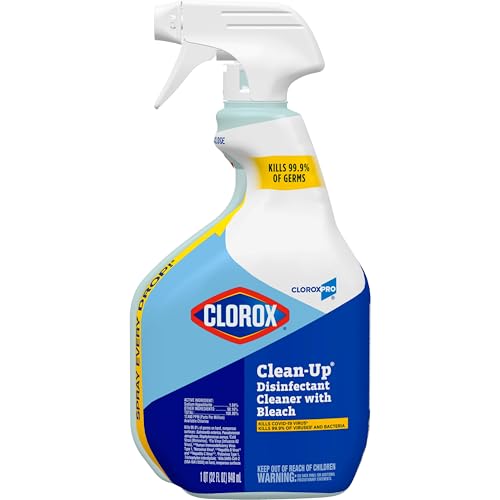
CloroxPro Clorox Clean-Up Disinfectant Cleaner with Bleach spray, 32 oz
Prices and availability are accurate as of the time shown and may change.
You want a bleach spray that cleans stains and kills germs fast on tile, ceramic, sinks and floors after a drain job.
You’ll use it around wood, worn laminate or old porcelain fixtures, or without safety glasses. Its label warns about both.
CloroxPro Clean-Up Disinfectant Cleaner with Bleach is the fast bleach spray, and I’ve used it. It’s one 32 oz trigger bottle, sold and shipped by Amazon when we checked. Its EPA registration is 67619-17, and the 1.84% sodium hypochlorite on the bottle matches EPA’s record.
It’s the quickest here on bacteria. Sprayed straight from the bottle, the label says the surface must stay wet for 30 seconds, and it adds 1 minute where poliovirus or norovirus is listed. That scored a 10 and a 9.
One wrinkle. EPA’s norovirus list shows 5 minutes for this registration, because the product also comes as a dilutable liquid. The 1-minute time is for the ready-to-use spray, from its own label table.
Clorox says it cleans and disinfects in one step when you follow the disinfecting directions. The listing adds tough stains, grease and grime, and odors caused by bacteria, mold and mildew. The label gives 5 minutes for mildew.
This is the strongest of the four, and the label says so. Its signal word is WARNING: it can cause substantial but temporary eye injury, so wear safety glasses and keep it off your skin and clothes. Like the other bleach pick, it says never to mix it with ammonia, acids, detergents, urine or feces.
Watch the surfaces. The pack lists ceramic, linoleum and glass. The label says it can discolor wood if misused and isn’t for unsealed, unfinished, worn, oiled or waxed wood. An optional line on its label adds that long contact with metal, old porcelain or worn plastic laminate may discolor them.
Food-contact surfaces need a rinse with drinking water after disinfecting. It isn’t on EPA’s C. diff spore list, and the WARNING label scored a 7 on handling.
My call: buy it for tile floors and sinks where you want speed, and wear glasses when you spray.
Disinfecting Multi-Surface Cleaner, 4 bottles of 26 oz
Prices and availability are accurate as of the time shown and may change.
You disinfect a kitchen sink, counter or disposal area after a repair, where the next thing on the surface is food or a kid’s toy.
You need a fast kill on a toilet or floor. Ten minutes wet is a long wait on a job.
Seventh Generation Disinfecting Multi-Surface Cleaner is the spray I’d use in a kitchen, and I’ve used it. This is a pack of four 26 oz bottles with two spray heads, sold and shipped by Amazon when we checked.
Its EPA number, 84683-3-86066, has three parts. EPA explains that means a distributor product with the same makeup and results as the primary product, here 84683-3, Benefect Botanical Daily Cleaner Disinfectant Spray. Seventh Generation lists 0.05% thymol, a compound found in thyme oil, which matches EPA’s record.
It’s the only pick you don’t rinse. Seventh Generation says to leave the surface wet, let it air-dry, and skip the rinse even on food-contact surfaces. The listing adds children’s toys. That scored a 10.
It’s also the mildest. Seventh Generation’s label text carries only “keep out of reach of children”, and the EPA-accepted label includes the line “No warning labels or first aid statements required.” That scored a 10 on handling.
The cost is time. To disinfect, the surface stays wet for 10 minutes. The label table gives 10 minutes for staph and MRSA and 5 for salmonella, flu and norovirus. To sanitize, it’s 1 minute. Those scored a 6 and a 7.
Seventh Generation lists the germs it kills: Pseudomonas, salmonella, staph, MRSA, E. coli, flu A, H1N1, rhinovirus, norovirus, the COVID-19 virus and two fungi. Greasy or soiled areas must be cleaned first, and it asks for a spot test.
Its ingredient list names citronella and lemongrass oils and notes that citral and geraniol are fragrance allergens. The pack says 0% dyes and artificial fragrances.
Seventh Generation says its Disinfecting Bathroom Cleaner is the same formula with a foaming nozzle; this bottle mists.
My call: use it on counters and sinks where food goes, and walk away for the 10 minutes.
Tap a column heading on a computer to sort by spec score.
| Pick | Spec score | Photo | Active | Bacteria | Norovirus | C. diff spores | Food contact | Short pros / cons | Buy |
|---|---|---|---|---|---|---|---|---|---|
| Clorox Healthcare Bleach Toilets and sewage | 9.0 | | 0.65% bleach | 1 min | 1 min | 3 min | Rinse after | Kills spores / Bleach | Check it on Amazon |
| CloroxPro EcoClean Bleach-free | 8.2 | | 0.4% lactic acid | 2 min | 30 s | Not listed | Rinse after | No PPE needed / 2 min bacteria | Check it on Amazon |
| CloroxPro Clean-Up Fast on tile | 8.0 | | 1.84% bleach | 30 s | 1 min | Not listed | Rinse after | 30-second kill / Safety glasses | Check it on Amazon |
| Seventh Generation No-rinse kitchens | 7.8 | | 0.05% thymol | 10 min | 5 min | Not listed | No rinse | Mildest label / 10 minutes wet | Check it on Amazon |
Times are how long the surface must stay wet, from each EPA-accepted label and EPA’s List G and List K, read Oct 22, 2026. Sellers and pack sizes from Amazon’s product data, Oct 22, 2026.
A disinfectant only works if the surface stays wet for the time on its label. EPA calls that the contact time. If it dries early, spray again.
| From the label | Clorox Healthcare | EcoClean | Clean-Up | Seventh Generation |
|---|---|---|---|---|
| EPA Reg. No. | 56392-7 | 67619-45 | 67619-17 | 84683-3-86066 |
| Active ingredient | Sodium hypochlorite 0.65% | L-lactic acid 0.4% | Sodium hypochlorite 1.84% | Thymol 0.05% |
| Bacteria (staph, MRSA) | 1 min | 2 min | 30 s | 10 min |
| Norovirus | 1 min | 30 s | 1 min spray | 5 min |
| C. diff spores (EPA List K) | 3 min | Not on the list | Not on the list | Not on the list |
| Sanitize (lower bacteria) | No sanitize time | 15 s, non-food surfaces | No sanitize time | 1 min |
| Signal word | CAUTION | CAUTION | WARNING | None required |
From the EPA-accepted labels for each registration (Clorox Professional Products, Ohso Clean), EPA’s List G and List K, and Seventh Generation’s product page, read Oct 22, 2026.
The marketing line on every bottle is “kills 99.9%”. The contact time is what tells them apart. A spray that needs 10 minutes and dries in 3 hasn’t disinfected anything, which is why EPA’s own guide says to keep the surface wet the whole time.
My call: on a toilet or a floor, use one of the 1-minute sprays and spray once more if the surface starts to dry.
Each row is a job that leaves germs behind, matched to the label fact that decides it.
| Job | My pick | The label fact behind it |
|---|---|---|
| Sewer backup into a bathroom or basement | Clorox Healthcare | On EPA’s C. diff spore list; label spells out cleaning fecal matter first |
| Pulling and resetting a toilet | Clorox Healthcare | 1 minute for most germs and norovirus; CAUTION label |
| Opening a cleanout indoors | Clorox Healthcare | Same fecal-waste cleanup steps on its label as a backup |
| Tile floor and tub after a drain clear | CloroxPro Clean-Up | 30 seconds for bacteria; cleans stains and grime |
| Kitchen sink and disposal after a repair | Seventh Generation | No rinse even on food-contact surfaces |
| Finished vanity, matte trim, stainless | CloroxPro EcoClean | No bleach; finished wood and stainless on its pack |
| Your own hand tools | CloroxPro EcoClean | No PPE required, per its pack; 2 minutes |
Every row starts the same way: clean the mess off first. All four labels say to pre-clean soiled surfaces, and Clorox Healthcare’s says fecal matter must be cleaned off before you disinfect. Spraying over sewage only wets it.
For the cleanup itself, our heavy duty cleaning wipes and shop towels pages cover what to wipe with, and our nitrile gloves page covers your hands.
EPA’s six steps, filled in with what Clorox Healthcare’s label says for a C. diff cleanup.
Find the EPA Reg. No. on the bottle. EPA says it’s the only sure way to identify a disinfectant, and it’s the number its pathogen lists use.
Check where the label says you can use it, which surfaces it lists, and the precautions.
Clorox Healthcare’s label asks for gloves, a gown, a mask or eye covering for C. diff jobs. Clean-Up’s label asks for safety glasses on every job.
The label says fecal matter must be cleaned off before disinfecting, by wiping or scrubbing until no soil shows. Clean the restroom last, and don’t reuse a dirty cloth.
Spray from 6 to 8 in until the surface is wet, and keep it wet for the full contact time. Spray again if it starts to dry.
Get rid of the cloths and wipes from the cleanup right away, as the label asks for anything that touched feces. Take off your gloves and wash your hands. Close the bottle and store it out of reach of children.
From EPA’s “6 Steps for Safe & Effective Disinfectant Use” and the EPA-accepted label for 56392-7, read Oct 22, 2026.
Both bleach labels carry the same hazard statement. On a drain job, all four of these can be within arm’s reach.
The Clorox Healthcare and Clean-Up labels name ammonia first. Many glass and household cleaners contain it.
Both labels name acids. Our sulfuric acid drain cleaner page covers one you may have in the same bathroom.
Both labels say not to mix bleach with other chemicals, detergents included.
Both labels name urine and feces. Mixing in a way the label doesn’t direct can release gases that irritate eyes, lungs and mucous membranes.
That last line is the one that surprises people, and it’s why the cleaning step comes first. My call: on a sewage job, scoop and wipe the waste, rinse, and only then spray the bleach. If a drain cleaner is still in the line, flush it before you clean the fixture.
It’s one of Google’s most-asked questions on this search. The labels answer it with two different times.
| Spray | Sanitize time | Disinfect time | Where the label allows sanitizing |
|---|---|---|---|
| CloroxPro EcoClean | 15 seconds | 2 minutes | Hard surfaces that aren’t for food |
| Seventh Generation | 1 minute | 10 minutes | Hard surfaces, food-contact included, no rinse |
EPA says a disinfectant destroys or inactivates bacteria, fungi and viruses on a surface, though not necessarily bacterial spores. Sanitizing is the shorter step: the labels give it to lower bacteria, not to kill every germ on the list.
My call: sanitize a counter you wipe every day. Disinfect anything that touched sewage, a toilet or a drain line, for the full time.
Three of the four say yes. One says no.
| Spray | On food-contact surfaces | Not for |
|---|---|---|
| Clorox Healthcare | Rinse with drinking water | Glassware, utensils or dishes |
| CloroxPro EcoClean | Rinse with drinking water | Eating utensils, glassware or cookware |
| CloroxPro Clean-Up | Rinse with drinking water after disinfecting | No item named |
| Seventh Generation | No rinse or wipe needed | None listed |
A kitchen sink repair ends at the counter, the drainboard and the disposal flange. If you won’t be there to rinse, leave Seventh Generation. If you used a bleach spray, wipe the counter with clean water before you pack up, as its label asks.
Another question Google shows on this search. The answer depends on the spray and on the finish.
| Spray | Surfaces its pack or label lists | Its warning about surfaces |
|---|---|---|
| Clorox Healthcare | Stainless steel, plastics, chrome, glazed porcelain, glass, vinyl | Not for dishes, glassware or utensils |
| CloroxPro EcoClean | Laminate, stainless steel, finished wood (finished, painted or sealed) | Not for eating utensils, glassware or cookware |
| CloroxPro Clean-Up | Ceramic, linoleum, glass | Can discolor wood; not for unsealed, unfinished, worn, oiled or waxed wood |
| Seventh Generation | Hard, nonporous surfaces, food-contact surfaces and children’s toys | Spot test first |
For a sealed or painted wood vanity, EcoClean is the only pick that names finished wood on its pack. Clean-Up’s label says it can discolor wood, and its optional label line adds metal, old porcelain and worn plastic laminate. My call: on any finish you’re unsure of, test a hidden corner first.
EPA says the registration number is the best way to tell what’s in the bottle, whatever the brand name says.
| Number on the bottle | Parts | What EPA says it means |
|---|---|---|
| 56392-7 (Clorox Healthcare) | Two | A primary registration; this is the number EPA’s lists use |
| 67619-45 (EcoClean) | Two | A primary registration |
| 67619-17 (Clean-Up) | Two | A primary registration |
| 84683-3-86066 (Seventh Generation) | Three | A distributor product; same makeup and results as 84683-3, which is what the lists show |
The same formula can be sold under several names. For example, 84683-3 is sold as Benefect as well as Seventh Generation. So when you check a spray against EPA’s norovirus or C. diff list, look up the first two parts of the number, not the brand.
Two picks are bleach and two aren’t. Here’s what that changes on a job.
| Bleach: Clorox Healthcare, Clean-Up | No bleach: EcoClean, Seventh Generation | |
|---|---|---|
| Active | Sodium hypochlorite 0.65% and 1.84% | Lactic acid 0.4%; thymol 0.05% |
| C. diff spores | Clorox Healthcare, 3 min | Neither is on List K |
| Mixing hazard | Never with ammonia, acids, detergents, urine or feces | No such statement on these labels |
| Signal word | CAUTION; WARNING | CAUTION; none required |
| Surfaces | Clean-Up can discolor wood and metal | EcoClean lists finished wood |
Bleach is the one I want on sewage, because of the spore claim. A bleach-free spray is what I’d use in a finished kitchen or bath where nothing came out of a drain, and on my own tools.
It’s the name most people know. Here’s why it isn’t scored here.
Lysol Disinfectant Spray, the one most people picture, is an aerosol can. This page compares trigger-spray cleaner-disinfectants, which clean and disinfect a hard surface in one product. An aerosol is a different kind of product, so it would need its own score.
We also looked at Lysol’s trigger sprays, the Power Foaming Bathroom Cleaner and the All Purpose Cleaner. EPA’s search shows several Lysol registrations with foamer and all-purpose names, and the Amazon photos don’t show the back label. We couldn’t tie either listing to one EPA number, so we couldn’t score it from a label.
We read each listing against the EPA label and the maker’s pages. These are the gaps we found on Oct 22, 2026.
| Spray | One source says | Another says | What to trust |
|---|---|---|---|
| Clorox Healthcare | Listing: kills over 50 microorganisms | Pack photo: kills over 60 pathogens | The label’s organism table |
| CloroxPro EcoClean | Listing: disinfects in 30 seconds | Pack and label: 2 minutes for bacteria | 30 s is for viruses; use 2 min |
| CloroxPro Clean-Up | EPA List G: 5 min for norovirus | Spray label: 1 min | 1 min for the spray; 5 min applies to the diluted form |
| CloroxPro Clean-Up | Listing: kills 99% of bacteria and viruses | Label lists named germs and times | The label |
| Seventh Generation | Bottle: EPA Reg. No. 84683-3-86066 | EPA lists: 84683-3 | Both; EPA says a three-part number matches its parent |
None of these gaps points to a fake product. Each bottle’s photo shows the same active ingredient and strength as its EPA record. The gaps are rounded counts and times written for one germ but read as the time for all of them.
These came up in searches and listings on Oct 22, 2026. Here’s what kept each one off the list.
| Spray | What we found | Why it’s out |
|---|---|---|
| Lysol Disinfectant Spray | Aerosol can | A different kind of product from these trigger sprays |
| Lysol Power Foaming Bathroom Cleaner | Trigger foamer | Couldn’t tie the listing to one EPA number |
| Lysol All Purpose Cleaner | Trigger spray | Couldn’t tie the listing to one EPA number |
| Scrubbing Bubbles Grime Fighter Disinfectant | Trigger spray | No active EPA product under that name in EPA’s search |
| Clorox Clean-Up, store version 3-pack | Trigger spray | Its name appears under several EPA numbers; we picked the CloroxPro bottle |
| Purell Professional Surface Disinfectant | Trigger spray | Not in stock when checked |
| Microban 24 Hour disinfectant | Aerosol can | Aerosol, and sold by a third party |
| Question | If yes | If no |
|---|---|---|
| Did sewage, a toilet or a drain line touch the surface? | Clorox Healthcare | Keep going |
| Is it a food-contact surface you won’t rinse? | Seventh Generation | Keep going |
| Is it finished wood, matte trim or a customer’s good vanity? | CloroxPro EcoClean | Keep going |
| Is it tile, ceramic or a sink where you want speed? | CloroxPro Clean-Up | Clorox Healthcare is the safest all-round pick |
My call for a plumbing truck: a bottle of Clorox Healthcare for sewage and toilets, and a bottle of EcoClean for finished rooms. A service company that does a lot of kitchen work can add Seventh Generation.
For a plumber’s dirty jobs, Clorox Healthcare Bleach Germicidal Cleaner. It kills most germs in 1 minute and is on EPA’s list for C. diff spores at 3 minutes. For a no-rinse kitchen spray, Seventh Generation; for no bleach, CloroxPro EcoClean.
Sanitizing lowers bacteria in a short time; disinfecting kills the full list of germs on the label. EcoClean sanitizes in 15 seconds and disinfects in 2 minutes. Seventh Generation sanitizes in 1 minute and disinfects in 10.
Only on finished wood, and only with a spray that allows it. EcoClean’s pack lists finished wood, meaning finished, painted or sealed. Clean-Up’s label says it can discolor wood and isn’t for unsealed, unfinished, worn, oiled or waxed wood.
As long as its label’s contact time, with the surface wet the whole time. Here that’s 30 seconds for Clean-Up on bacteria, 1 minute for Clorox Healthcare, 2 minutes for EcoClean and 10 minutes for Seventh Generation.
A product on EPA’s List K. Of these four, only Clorox Healthcare Bleach Germicidal Cleaner, EPA Reg. No. 56392-7, is on it, with a 3-minute contact time. EPA says disinfectants don’t necessarily kill bacterial spores.
All four are on EPA’s norovirus list, List G. EcoClean is fastest at 30 seconds, Clorox Healthcare takes 1 minute, Clean-Up takes 1 minute as a spray, and Seventh Generation takes 5 minutes.
Look at the label, not the name. Clorox Healthcare is sold for hospitals, and what sets it apart here is its spore claim on EPA’s List K. Check any spray’s EPA number against the list for the germ you’re worried about.
No. Both bleach labels here say not to mix with ammonia, acids, detergents, urine or feces, which can release gases that irritate eyes and lungs. Clean the mess off first, then spray.
On food-contact surfaces, three of the four say to rinse with drinking water. Seventh Generation says no rinse or wipe is needed, even on food-contact surfaces.
Find the EPA Reg. No. on the bottle and look up the first two parts on EPA’s lists. EPA says a three-part number is a distributor product with the same makeup and results as the two-part one.
Gear up, clean the waste off first, then spray a disinfectant and keep the surface wet for its full contact time. Clorox Healthcare’s label spells out that order for fecal matter, with a 3-minute time for C. diff spores.
Yes. It’s EPA-registered as 84683-3-86066, a distributor version of 84683-3, which is on EPA’s norovirus list. It needs 10 minutes wet to disinfect, the longest of the four.
I’m Isaac Daniels, a licensed journeyman plumber in Georgia (license #JP507711), and I’ve used all four picks. Every kill time and warning here comes from the EPA-accepted label for each spray’s registration, EPA’s own pathogen lists and the makers’ pages, read Oct 22, 2026. Where I add advice of my own, it’s labeled as my call.
Each check scores 0 to 10 and counts one fifth. Anything the label doesn’t state scores a neutral 5. It’s our score from EPA documents, not a customer rating or a lab test of our own.
| Check (weight) | How it’s scored |
|---|---|
| Bacteria kill time (⅕) | Longest spray time for staph and MRSA on the label: 10 for 30 seconds or less; 9 for 1 minute; 8 for 2 to 3 minutes; 7 for 5 minutes; 6 for 10 minutes |
| Norovirus kill time (⅕) | Spray time on the label or EPA’s List G: 10 for 30 seconds or less; 9 for 1 minute; 8 for 2 to 3 minutes; 7 for 5 minutes; 6 for 10 minutes; 5 when not listed |
| C. diff spores (⅕) | 10 when the registration is on EPA’s List K; 6 when it isn’t |
| Food-contact use (⅕) | 10 when no rinse is needed; 8 when a drinking-water rinse is required; 6 when not for food-contact surfaces |
| Handling (⅕) | The label’s signal word: 10 for none required; 9 for CAUTION; 7 for WARNING; 5 for DANGER |
| Total | Average of the checks, to one decimal |
| Pick | Bacteria | Norovirus | C. diff | Food contact | Handling | Score |
|---|---|---|---|---|---|---|
| Clorox Healthcare | 9 (1 min) | 9 (1 min) | 10 (List K) | 8 (rinse) | 9 (CAUTION) | 9.0 |
| CloroxPro EcoClean | 8 (2 min) | 10 (30 s) | 6 (not listed) | 8 (rinse) | 9 (CAUTION) | 8.2 |
| CloroxPro Clean-Up | 10 (30 s) | 9 (1 min) | 6 (not listed) | 8 (rinse) | 7 (WARNING) | 8.0 |
| Seventh Generation | 6 (10 min) | 7 (5 min) | 6 (not listed) | 10 (no rinse) | 10 (none) | 7.8 |