
Picks by need
Two are linked. I keep Viega as a design reference here, with no verified Amazon offer linked. Ratings come from Eastman and Viega, not the listings. The brass nipple has its own section further down. [4] [5] [6]
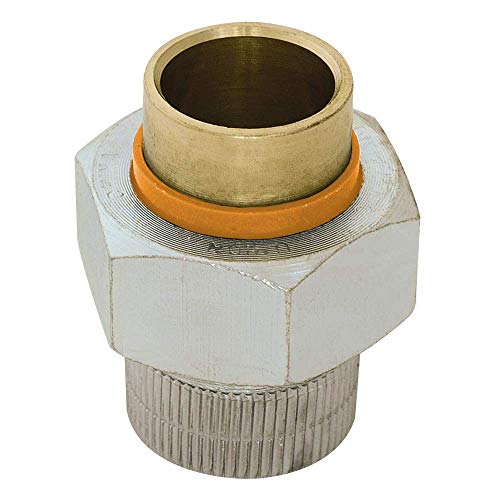
Product photo from the Amazon listing.
Best for soldered ¾ in. copper at a tank heater
Eastman EZ-20503

Product photo from the Amazon listing.
Best for ½ in. lines and small tankless heaters
Eastman 20501
For pressed copper, read the Viega 79160 design reference. I have not added a buy link for that fitting. [5]
Product prices and availability are accurate as of the date/time indicated and are subject to change. Any price and availability information displayed on Amazon.com at the time of purchase will apply to the purchase of this product.
What’s inside each joint
A union puts plastic and rubber between the steel and the copper side. A brass nipple is one piece of metal. [6] [7]
Watts lists the parts of a typical dielectric union plainly: a lead-free brass tailpiece, a zinc-plated steel adapter and nut, a polysulfone insulator and a gasket. The steel adapter threads onto the steel pipe, the brass tailpiece takes the copper, and the plastic and rubber keep the two metals from touching. [7]
Watts says its unions are factory tested to hold 600 V on a dry line without flashover. The insulating parts separate the metal ends. A dry-line withstand test is not a guarantee of zero current through a filled plumbing system. [7]
A brass nipple does none of that. LASCO’s 17-9501 is lead-free brass, threaded male on both ends, with no gasket and no insulator. It threads into a female steel fitting on one end and a copper female adapter on the other. [6]
The cited model-code transition sections permit both fitting categories, subject to the actual installation and local approval. The 2024 IPC section 605.23.1 allows a copper-alloy fitting, a dielectric fitting or a dielectric union between copper and galvanized steel. Brass is a copper alloy. [1]
Dielectric unions
Best for soldered ¾ in. copper at a tank heater
Eastman EZ-20503
Dielectric union, ¾ in. FIP × ¾ in. solder
Prices and availability are accurate as of the time shown and may change.
Pros
- Comes apart at the nut for heater swaps
- 250 psi at 180°F
- Steel FIP end threads onto heater nipples
- In Eastman’s 2025 catalog
Cons
- Gasket limit 180°F
- Eastman prints no lead-free mark
- No ASSE 1079 mark on Eastman’s page
- Take it apart before soldering
- Breaks the pipe’s ground path
Buy it if
You’re soldering ¾ in. copper to the steel nipples of a tank water heater, or to a male steel thread anywhere else. [4] [5]
Skip it if
Your copper is pressed, not soldered. The Viega 79160 presses on with no torch.
The EZ-20503 is Eastman’s ¾ in. dielectric union: a steel female pipe thread (FIP) on one end and a brass solder end for ¾ in. copper on the other. Eastman lists the older 20503 as discontinued and replaced by the EZ-20503. Amazon’s title retains 20503 while its model field says EZ-20503. I confirm the delivered part marking and required approvals before installing it. [4]
Eastman’s product page describes it as galvanized steel with a steel end and a brass end for soldering. The threaded connection and the nut are steel. So steel stays on the steel side, brass meets the copper, and the gasket sits between them. [4]
The seal is a silicone rubber gasket with a nylon insert. Eastman rates the union to 250 psi at 180°F. On a tank heater, 180°F has room: A.O. Smith ships its electric tank heaters set to about 120°F. [4] [8]
The FIP end takes a male thread. On a tank heater, that’s the nipple in the top of the tank. A.O. Smith’s electric heater guide says to connect ¾ in. NPT to the cold inlet nipple and recommends a dielectric-type union there. [8]
Heat is the install risk. The gasket is rated to 180°F, and a torch runs far hotter. I’d unscrew the nut and slide the steel half and gasket off before soldering the brass end, then let the brass cool before putting it back together. [4] [5]
Two papers are thin. Eastman’s catalog and page print no lead-free mark; the Amazon listing says it meets lead-free standards, and federal law has required lead-free fittings for drinking water since January 4, 2014. Neither Eastman document names ASSE 1079, the standard IPC 605.23.1 cites, so look for the mark on the box. [1] [4] [11]
It comes apart at the nut, which is why heater makers want a union here. A.O. Smith’s guide says a union lets you remove the heater for service or replacement without cutting pipe. Two wrenches on the nut and the tank side is free. [8]
My call: for soldered ¾ in. copper to a tank heater’s steel nipples, it’s the union I’d reach for first. If you press copper instead of soldering it, go to the Viega below. [5]
Viega ProPress 79160
Dielectric union, model 2967ZL, ¾ in. press × female thread
Information reference only; there is no verified Amazon offer linked here.
Pros
- No torch near the gasket
- EPDM seals rated 0 to 250°F
- Zero Lead silicon bronze, per Viega
- Smart Connect flags an unpressed joint
- ProPress system rated to 300 psi
Cons
- Needs a ProPress tool and jaws
- No verified Amazon offer linked here
- ASSE 1079 per Viega’s tech data sheet; potable use not listed there
- IPC 605.23.1 text says soldered
- Breaks the pipe’s ground path
The 79160 is the ¾ in. size of Viega’s ProPress dielectric union, model 2967ZL: a press end for ¾ in. copper tube and a female pipe thread for steel. Viega makes it from ½ to 2 in., articles 79155 to 79180. [5]
Viega’s 2967ZL tech data sheet lists a zero lead bronze ProPress end, a galvanized female NPT end and nut, EPDM seals and an electrical separation ring, and says it meets ASSE 1079 for electrical isolation and corrosion resistance. [1] [5]
The same sheet lists general utility, chilled water, hydronic heating, vacuum and compressed air service and doesn’t list drinking water, so confirm potable use with Viega and your inspector before putting it on a water heater supply. Viega’s install manual says Zero Lead means the product meets the lead-free rules of NSF/ANSI/CAN 61, tested under NSF/ANSI/CAN 372: a weighted average of 0.25% lead or less. [5] [11]
The seals are EPDM: a flat gasket at the union and an EPDM sealing element in the press end. Viega’s ProPress manual rates its EPDM element from 0 to 250°F and the ProPress system to 300 psi, but those are system figures; the 2967ZL sheet prints no temperature or pressure rating of its own, so ask Viega for the union’s limits. [5]
There’s no torch. You cut the tube square, deburr it, mark the insertion depth, ⅞ in. on ¾ in. tube per Viega’s table, and press it with a ProPress tool. My press tool guide compares them. [5]
The green dot is Viega’s Smart Connect. Viega says it helps you find an unpressed fitting during a leak test. Viega also says it doesn’t replace the leak test your local code requires. [5]
Code reads a little differently for press. IPC 605.23.1 says the copper is soldered to the fitting. IRC P2906.18.1 says joined in an approved manner, and IPC 605.23 allows mechanical joints between different materials. Ask your inspector. Viega’s tech data sheet says the 2967ZL meets ASSE 1079. [1] [2] [5]
Viega’s manual is plain on mixed metal: dielectric unions from copper to steel or galvanized steel. If you solder nearby later, Viega wants the solder joint at least 2¼ in. from an existing ¾ in. ProPress fitting, kept cool with a wet rag or heat gel. [5]
Best for ½ in. lines and small tankless heaters
Eastman 20501
Dielectric union, ½ in. FIP × ½ in. solder
Prices and availability are accurate as of the time shown and may change.
Pros
- Same 250 psi at 180°F rating
- Fits ½ in. heater and branch lines
- Comes apart at the nut
- Current part in Eastman’s 2025 catalog
Cons
- Gasket limit 180°F
- Eastman prints no lead-free mark
- No ASSE 1079 mark on Eastman’s page
- Take it apart before soldering
- Breaks the pipe’s ground path
Buy it if
Your steel thread and copper are both ½ in.: a small electric tankless heater, or a ½ in. galvanized branch being re-piped in copper. [4] [5]
The 20501 is the ½ in. size of the same Eastman union: a ½ in. FIP steel end and a ½ in. brass solder end. Eastman’s 2025 catalog lists it as a current part. [4]
Its ratings match the ¾ in. size: 250 psi at 180°F, a silicone rubber gasket with a nylon insert, and a steel threaded end and nut. Eastman lists it for use with copper, brass and steel pipe. [4]
Where does ½ in. come up? Small electric tankless heaters, for one. EcoSmart’s ECO 12, 18 and 27 manual lists ½ in. dielectric unions for the 12 kW model and ¾ in. for the 18 and 27 kW. Check your own heater’s manual for its connection size. [10]
It also fits ½ in. branch lines where old galvanized pipe meets new copper, like a sink supply or a hose bib being re-piped. IPC 605.23.1 covers any copper-to-galvanized joint in the water supply, not only the ones at a heater. [1]
The cautions are the same as the ¾ in. size. Eastman prints no lead figure, its page shows no ASSE 1079 mark, and the 180°F gasket has to stay away from the torch. Take the nut off and solder the brass end alone. [1] [4]
Grounding matters on tankless heaters too. Navien’s NPE-A2 manual says not to attach the heater’s ground wire to the water piping, because plastic pipe or dielectric unions may prevent proper grounding. A union breaks that metal path by design. [9]
Eastman’s catalog also lists a ¾ in. FIP by ½ in. solder union, EZ-20513, if the heater port is ¾ in. and your copper is ½ in. It isn’t linked here. [4]
My call: for ½ in. copper to a ½ in. steel thread, it’s the same Eastman design in the smaller size, and Amazon.com sells it. [4]
Reference: the brass nipple (not linked)
| LASCO 17-9501 | What LASCO and the code say |
|---|---|
| Size and ends | ¾ × 6 in., male pipe thread on both ends |
| Material | Lead-free brass, described as lead-free in the archived maker page |
| Seal | No gasket and no insulator |
| Heat and pressure | Not stated on the maker page checked |
| Use | Air, water or gas |
| Comes apart | No |
| Code | A copper-alloy fitting under IPC 605.23.1 and IRC P2906.18.1 |
| Suits | The steel side is a female thread, like a galvanized tee, coupling or valve, and the joint will stay put for years. |
| Doesn’t suit | The heater has to come out someday without cutting pipe. A union like the Eastman EZ-20503 comes apart. |
| On Amazon | Reference (not linked) |
The 17-9501 is LASCO’s ¾ by 6 in. brass pipe nipple, with male pipe thread on both ends. The archived LASCO page describes it as lead-free brass, for air, water or gas. [6]
This is the other route code allows. IPC 605.23.1 accepts a copper-alloy fitting between copper and galvanized steel, and brass is a copper alloy. IRC P2906.18.1 says the same thing: a copper alloy fitting or a dielectric fitting. [1] [2]
It works differently from a union. Nothing in it insulates; it’s metal from end to end, so it doesn’t break the electrical path. What it gives you is a joint with no gasket to dry out, harden or overheat. [6] [1] [2]
It has no gasket, but that doesn’t mean it has no temperature limit. The LASCO product page I checked gives no temperature or pressure rating for the nipple, so the nipple’s own limits are unverified. Ask LASCO for them, and check every other part of the joint too. [6]
| Where the nipple does well | Where it falls short |
|---|---|
| No gasket to age or overheat | Doesn’t come apart |
| Lead-free brass, per LASCO | Needs a female steel fitting |
| Archived lead-free maker description, per LASCO | Needs a copper female adapter too |
| Code-accepted copper-alloy fitting | No temperature rating published |
| Doesn’t interrupt the metal path (not proof of bonding) | No heater maker I read names it |
Fit is the opposite of the Eastman union. The nipple is male on both ends, so the steel side needs a female thread: a tee, a coupling or a valve port. The copper side takes a ¾ in. copper female adapter, soldered or pressed onto the tube. [4]
It doesn’t come apart. A.O. Smith’s guide asks for a union at the heater so the tank can come out for service. With a nipple there, add a separate union on the copper side, or plan to cut the pipe when the heater is replaced. [8]
Lead matters here because the whole bore is wetted brass. LASCO’s page says lead free, and federal law since January 4, 2014 caps wetted surfaces at a 0.25% weighted average. I dropped an older nipple pick because its maker printed no lead figure. [6] [11]
Neither the 2024 IPC nor the IRC names a nipple length, so 6 in. is a choice, not a rule. Where the steel side is female and the joint stays put, it’s the simplest code-accepted transition. [1] [2]
I keep LASCO’s 17-9501 as an information reference, with no verified Amazon offer linked. A nipple is a different kind of fitting from the unions, so I compare its fit separately. [6]
Dielectric union and brass nipple side by side
From the picks’ maker documents and the 2024 IPC and IRC. The comparison stacks into labeled rows on a phone. [1] [2]
| Check | Dielectric union | Brass nipple | Ahead |
|---|---|---|---|
| Allowed by IPC 605.23.1 | Yes, to ASSE 1079 | Yes, as a copper-alloy fitting | Tie |
| Breaks the metal path | Yes: insulator and gasket | No | Union |
| Comes apart | Yes, at the nut | No | Union |
| Rubber parts | Gasket: 180°F (Eastman) or 250°F (Viega) | None | Nipple |
| Lead-free papers | Viega: Zero Lead; Eastman: not printed | LASCO: lead free | Nipple and Viega |
| Steel side it fits | Male thread (these FIP picks) | Female thread | Depends on your fitting |
| Joints to make | One solder or press joint | Plus a copper female adapter | Union |
| Ground path through the pipe | Broken | Kept | Nipple |
| What heater makers name | A.O. Smith, EcoSmart, Viega: dielectric union | None of the four names a nipple | Union |
Neither one wins everywhere. The union wins where the joint has to come apart or the heater maker asks for one. The nipple wins on fewer rubber parts, a printed lead-free claim and a metal path the joint doesn’t interrupt (an electrician still confirms the bond). [1] [4] [5] [6]
The two unions, one reference and the nipple compared
From each maker’s own page or catalog. The comparison stacks into labeled rows on a phone.
| Fitting | Type | Ends | Heat limit | Pressure | Lead-free papers | Comes apart | Buy |
|---|---|---|---|---|---|---|---|
| Eastman EZ-20503 | Dielectric union | ¾ in. FIP × ¾ in. solder | 180°F | 250 psi | Not printed by Eastman | Yes | View Eastman EZ-20503 on Amazon |
| Viega ProPress 79160 | Dielectric union | ¾ in. press × FPT | EPDM seal only: 0 to 250°F. Confirm the complete union’s limit with Viega. | 300 psi system | Zero Lead | Yes | Reference (not linked) |
| LASCO 17-9501 | Brass nipple | ¾ in. MIP × MIP, 6 in. | No gasket | Not published | Lead free | No | Reference (not linked) |
| Eastman 20501 | Dielectric union | ½ in. FIP × ½ in. solder | 180°F | 250 psi | Not printed by Eastman | Yes | View Eastman 20501 on Amazon |
Why copper and steel need a transition fitting
Water plus two different metals makes a small battery. The steel side loses.
| Source | What it says |
|---|---|
| A.O. Smith service handbook 321547-000 | When dissimilar metals are in contact with water, a galvanic cell will likely result, and corrosion of the metal parts will occur. |
| A.O. Smith electric heater guide | We recommend a dielectric-type union; it can help prevent corrosion from tiny currents common in copper water pipes and help extend the heater’s life. |
| Watts ES-LF3001A | Installed between pipe of dissimilar metals to prevent accelerated corrosion from galvanic and stray current. |
| Viega ProPress manual IM-PP | Use dielectric unions from copper to steel or galvanized steel. Don’t install copper tubing directly upstream from galvanized steel pipe. |
| 2024 IPC 605.23.1 | Copper to galvanized steel: a copper-alloy or dielectric fitting, or a dielectric union to ASSE 1079. |
The Viega line about flow is the one people miss. In a mixed system, copper should sit downstream of galvanized steel, not upstream of it. Viega calls it the flow rule and says it must be observed wherever copper and galvanized steel share a line. [5]
So when you re-pipe half a house in copper, the order of the pipe matters as much as the joint between them. [1] [5] [7] [8]
Most of these joints happen at the water heater. A steel tank with ¾ in. steel nipples meets copper supply lines, and the joint has to carry hot water every day. That’s why heater makers have an opinion on it, and why heat limits matter later on this page. [1] [5] [7] [8]
How hot each one can run
The gasket sets a union’s limit. A brass nipple has no gasket.
For a house water heater, every union here has room. A.O. Smith ships its electric tank heaters set to about 120°F, and the lowest union rating on this page is 180°F. The general ProPress EPDM seal range reaches 250°F; it does not establish the complete 2967ZL union’s service rating. [5] [8]
The Watts bars show why the gasket matters. Its standard gasket stops at 180°F; its EPDM gasket B goes to 300°F but only at 50 psi. Watts lists gasket B for steam and hot water applications. [7]
The number to protect is the one during install. A torch on the brass end of a union heats the gasket far past any rating here. That’s why I’d always take a solder union apart first, or use the press version and skip the flame. [4] [5] [7] [8]
A brass nipple has no gasket, so the torch only reaches the copper adapter you solder on the far end. [6]
| Part | Temperature | Pressure | Source |
|---|---|---|---|
| Eastman EZ-20503 and 20501 | 180°F | 250 psi | Eastman catalog 2025; product page |
| Viega 2967ZL EPDM seal | 0 to 250°F | 300 psi (ProPress system) | Viega IM-PP |
| Watts LF3001A, gasket A | 180°F | 250 psi | Watts ES-LF3001A |
| Watts LF3001A, gasket B (EPDM) | 300°F | 50 psi | Watts ES-LF3001A |
| LASCO 17-9501 | Not published | Not published | LASCO product page |
| A.O. Smith tank, factory setting | About 120°F | Not applicable | A.O. Smith guide 100341465 |
What the plumbing code says
Read on codes.iccsafe.org, Oct 21, 2026. Georgia adopted the 2024 IPC on Jan 1, 2026, and its state amendments leave 605.23.1 as written. [1] [3]
| Code | Section | What it allows |
|---|---|---|
| 2024 IPC | 605.23 | Joints between different materials: a mechanical joint of the compression or mechanical-sealing type, or 605.23.1 to 605.23.3. Adapters need an ASTM F477 elastomeric seal. |
| 2024 IPC | 605.23.1 | Copper to galvanized steel: a copper-alloy or dielectric fitting, or a dielectric union to ASSE 1079. Copper soldered to the fitting; fitting screwed to the pipe. |
| 2024 IPC | 605.23.3 | Stainless steel: compression or mechanical-sealing joint, or a dielectric fitting or union to ASSE 1079. |
| 2024 IRC | P2906.18.1 | Copper to galvanized steel: a copper alloy fitting or dielectric fitting. Copper joined in an approved manner; fitting screwed to the pipe. |
| 2024 IRC | P2906.18.4 | Stainless steel: compression or mechanical-sealing joint, or a dielectric fitting. |
| Georgia (2024 IPC, amended) | 605.23.1 | Not amended by Georgia: copper-alloy or dielectric fitting, or ASSE 1079 dielectric union. |
Read 605.23.1 closely and the brass nipple question answers itself. A copper-alloy fitting is listed right next to the dielectric union. These mixed-metal sections do not themselves require a union or set a nipple length. Equipment connection rules and the heater manual still apply. [1] [6]
The IRC, which covers one- and two-family houses, is even shorter. It names a copper alloy fitting or a dielectric fitting and stops there. [2]
Two details matter for the picks. The IPC asks that a dielectric union meet ASSE 1079, Viega’s 2967ZL tech data sheet says it does; Eastman’s pages I read don’t show the mark, so look for it on the fitting or the box. [1] [4] [5]
The IPC text also says the copper is soldered to the fitting. A press union like the Viega leans on 605.23’s mechanical joint path, or the IRC’s “approved manner”. Your inspector makes that call. [1] [2] [5]
Your local code wins. Some states and cities adopt their own plumbing code, or amend the IPC or UPC. Call your building department before you choose between a union and a nipple on a permitted job. [1]
What water heater makers say about it
From the install manuals. Your heater’s own manual comes first.
| Maker | Document | What it says |
|---|---|---|
| A.O. Smith | Residential electric use and care guide | Connect with a union for removal; “We recommend using a dielectric-type union.” Factory set about 120°F. |
| A.O. Smith | Hybrid heat pump service handbook 321547-000 | Parts list includes “Nipple, Dielectric, PEX Lined, 3-inch”, part 9005883115. |
| Navien | NPE-A2 installation manual | Don’t attach the ground wire to the water piping; “dielectric unions may prevent proper grounding”. |
| EcoSmart | ECO 12/18/27 manual | Lists ½ in. dielectric unions for the 12 kW model, ¾ in. for 18 and 27 kW. |
| Viega | ProPress installation manual IM-PP | Dielectric unions from copper to steel; copper not directly upstream of galvanized steel. |
Some tanks already use lined dielectric nipples. A.O. Smith’s hybrid heater parts list names a PEX-lined nipple. That lining is not proof of complete electrical isolation of the whole tank connection. I check the heater’s parts list and instructions before adding another fitting. [8]
None of the four makers I read names a plain brass nipple. That doesn’t bar it; code still allows it. It means the heater maker’s own advice points to a union. [6]
Tankless heaters bring the most specific advice. EcoSmart lists dielectric unions in its parts and tools for each model. Navien warns that those same unions can cut the ground path through the pipe. My tankless water heater guide covers the heaters themselves. [9] [10]
What a union does to the ground path
A union is built to stop current. Some houses use the water pipe as part of their grounding. [7] [9]
Watts tests its unions to hold 600 V on a dry line without flashover. A union can interrupt a grounding or bonding path that relies on metal piping. An electrician must assess the actual installation. [7]
Navien says never to attach the heater’s ground wire to the water piping, because dielectric unions may prevent proper grounding. [9]
This is the one place the brass nipple differs in a way most guides skip, though a continuous brass path is not proof of safe bonding. A union is doing its job when it stops current, and that same job can cut a bond the house was counting on. How to restore that bond is an electrician’s call under your local electrical code. [6]
Which one fits the fittings you have
Start from the steel side. Male or female thread decides most jobs.
| Steel side | Copper side | Fits | Pick |
|---|---|---|---|
| Male ¾ in. thread (heater nipple) | ¾ in. copper, soldered | FIP × solder union | View Eastman EZ-20503 on Amazon |
| Male ¾ in. thread (heater nipple) | ¾ in. copper, pressed | FPT × press union | Reference (not linked) |
| Male ½ in. thread | ½ in. copper, soldered | FIP × solder union | View Eastman 20501 on Amazon |
| Female ¾ in. thread (tee, coupling, valve) | ¾ in. copper, any joint | Brass nipple plus a copper female adapter | Reference (not linked) |
| Male ¾ in. thread | ½ in. copper | Eastman EZ-20513, ¾ FIP × ½ solder | Not linked |
| Female ¾ in. thread, union wanted | ¾ in. copper, soldered | Eastman 20515, ¾ MIP × ¾ solder | Not linked |
The FIP unions here thread onto a male end. On a tank heater, that’s the steel nipple in the tank top, which A.O. Smith gives as ¾ in. NPT. If the steel side is a female fitting instead, you either thread in a nipple or use a male-threaded union like Eastman’s 20515. [4] [8]
My MIP vs FIP guide explains the thread names.
A union seals at the gasket under the nut, not at the threads, so keep that face clean. On the copper side, a soldered joint needs lead-free solder and flux; see my solder and flux guide. [1] [4] [5]
- 1
Identify the steel thread
A male steel nipple takes the female end of the union. A female steel fitting can take the male end of a brass nipple. I match the size stamped on the fitting before buying. [6]
- 2
- 3
How each one goes in
The order matters more than the parts. Heat is the thing to keep off the gasket. [4] [5]
| Step | Solder union (Eastman) | Press union (Viega) | Brass nipple (LASCO) |
|---|---|---|---|
| Before heat | Unscrew the nut; take the steel half and gasket off the brass end | No heat at all | Thread the nipple into the steel fitting first |
| Copper joint | Solder the brass end to the copper, let it cool | Mark ⅞ in. insertion depth, press with a ProPress tool | Solder or press a copper female adapter, then thread it on |
| Steel joint | Thread the steel half onto the male steel thread | Thread the female end onto the male steel thread | Done in step one |
| Close it up | Seat the gasket, tighten the nut | Already sealed at the press | Nothing to close |
| Test | Pressure test per local code | Leak test; Smart Connect flags an unpressed joint | Pressure test per local code |
On the nipple route, solder the copper adapter to the tube before you thread it onto the nipple when you can. That keeps the torch away from the threaded joint, and it’s easier to turn a short adapter than a long copper run. [4] [5]
For pressed copper anywhere near a solder joint, Viega wants 2¼ in. between a ¾ in. ProPress fitting and new solder work. My ProPress vs soldering guide compares the two methods. [5]
- 1
- 2
- 3
When to pick each one
The Eastman EZ-20503 on each ¾ in. heater nipple. It comes apart for the next heater swap. [4]
The Viega 79160. No torch at the connection. Confirm the complete union’s service limits with Viega. [5]
The LASCO 6 in. brass nipple and a copper female adapter. No gasket to age.
The Eastman 20501, after checking the heater’s manual for its connection size.
Call an electrician before you add any union. A nipple keeps the path whole.
Viega says not to. Re-plan the run so copper sits downstream.
Where the documents disagree
Five places the papers, or the listings, don’t match, and what to go by.
| Topic | One source says | The other says | Go by |
|---|---|---|---|
| Eastman union body | Catalog: “constructed of a highly-durable brass” | Product page: galvanized steel, with a brass solder end | Steel end and nut, brass solder end |
| Eastman lead-free | Amazon listing: meets lead-free standards | Eastman catalog and page: no lead figure | Ask Eastman, or use Viega or LASCO |
| ASSE 1079 | IPC 605.23.1: unions conform to ASSE 1079 | Eastman pages: no ASSE mark shown; Viega’s sheet: meets ASSE 1079 | The mark on the box |
| Soldered or pressed | IPC 605.23.1: copper soldered to the fitting | IRC P2906.18.1: joined in an approved manner | Your inspector |
| Eastman 60098 nipples | Amazon listing: “dielectric” heat trap nipples | Eastman catalog: galvanized heat trap nipples; 60095 is the lined dielectric one | The catalog |
The 60098 row is why I don’t trust listing titles for this part. The listing calls the nipples dielectric; Eastman’s own catalog lists them as galvanized heat trap nipples and puts its Teflon-lined dielectric nipple under 60095. I left both off the picks. [4]
On lead-free, the safest papers here are Viega’s Zero Lead statement and LASCO’s lead-free listing.
The archived LASCO description calls the nipple lead-free, while LASCO’s dated Proposition 65 list names lead for the same part number. A warning list alone does not establish drinking-water compliance either way. I require current lead-free and potable-water documentation for the exact nipple before using it on drinking water. [6]
Should you use a dielectric union or a brass nipple?
| Question | If yes | If no |
|---|---|---|
| Will this joint ever need to come apart, like at a heater? | Union | Either; keep going |
| Is the steel side a male thread? | FIP union (Eastman or Viega) | Brass nipple, or a MIP union |
| Is the copper pressed, not soldered? | Viega 79160 | Eastman solder union |
| Does a ground or bond clamp sit on this pipe? | Electrician first, whichever fitting you use | Keep going |
| Is it a drinking-water line, and does the fitting carry a lead-free mark (and ASSE 1079 for a union) and a listing for potable use? | OK to use, if your inspector accepts it | Don’t install it on drinking water |
| Does the heater manual name a union? | Use what it names | Your choice |
At a water heater, I’d use a union: the heater makers ask for one, and the next heater swap is two nuts instead of two cuts. On a pipe that won’t move for decades, like copper into a galvanized tee in a crawlspace, the brass nipple is simpler and has nothing to wear out. [6]
Either way, the copper side is ordinary copper work. My copper union guide covers plain unions, and my copper press fittings guide covers ProPress. [5]
Questions people ask
What is a dielectric union?
A union that joins copper to steel with plastic and rubber between them, so the metals don’t touch. Watts lists a brass tailpiece, a zinc-plated steel adapter and nut, a polysulfone insulator and a gasket. It comes apart at the nut. [7]
Is a dielectric union needed on a water heater?
Do you need a dielectric union between copper and steel?
Can I use a brass nipple instead of a dielectric union?
Can a dielectric union be reused?
Does a dielectric union need to be lead-free?
How hot can a dielectric union get?
Can you solder a dielectric union without taking it apart?
I wouldn’t. The Eastman gasket is rated to 180°F, far below torch heat. Take the nut off, solder the brass end alone, let it cool, then reassemble. [4]
Can you press a dielectric union?
Do dielectric unions break the electrical ground?
They break the metal path through the pipe. Navien’s manual says not to attach a heater ground wire to the water piping because dielectric unions may prevent proper grounding. Ask an electrician about bonding. [9]
Which way does a dielectric union go?
Steel end on the steel pipe, brass end on the copper. On the Eastman, the steel FIP end threads onto the male steel nipple and the brass end is soldered to the copper tube. [4]
How I compared them
How I chose
I compared four fittings: Eastman EZ-20503, Eastman 20501, Viega 79160 and LASCO 17-9501. I checked Eastman’s catalog, the current listing identities, the code sections, heater instructions and Viega’s exact data sheet. The two Eastman unions are the Amazon picks; Viega and LASCO remain information references. [4] [5] [6]
I checked CPSC recall records for Eastman, EZ-FLO, Viega, LASCO and Watts on November 15, 2026. No matching recall for these fittings appeared. Eastman 60098 and 60095 remain outside the picks because their heat-trap and dielectric descriptions differ. [4] [5] [6] [7]
I keep the installation method separate from the service rating. A press connection needs the right tool, while a solder union needs heat kept away from its seal. I confirm the complete fitting’s approved service rather than treating a general system figure as its rating. [4] [5]
Sources
- International Plumbing Code 2024, sections 605.23, 605.23.1 and 605.23.3. Copper-alloy transition route and ASSE 1079 dielectric-union route. Read the source
- International Residential Code 2024, P2906.18.1 and P2906.18.4. Approved joining of copper to galvanized steel. Read the source
- Georgia DCA, current state minimum codes and 2026 IPC amendments. The 2024 IPC applies with Georgia amendments; section 605.23.1 is not amended. Read the source
- Eastman, Water Heater Installation and Repair Catalog 2025, pages 36 and 37, plus Dielectric Union product page. Exact sizes, silicone gasket, nylon insert, steel hardware and 250 psi at 180°F. Read the source
- Viega, ProPress dielectric union 2967ZL technical data, May 2026, plus ProPress installation manual IM-PP. Article 79160 is ¾ in. press × female thread. General ProPress ratings are not a complete-union rating. Read the source
- LASCO, archived 17-9501 maker description and carded brass nipple catalog. The archived description calls it lead-free; the maker’s dated Proposition 65 list also names lead for this part. I require current potable-water documentation for the exact delivered fitting. Read the source
- Watts, ES-LF3001A and ES-LF3002 specifications. Construction, dry-line dielectric test and separate gasket temperature/pressure limits. Read the source
- A.O. Smith, residential electric water heater use and care guide 100341465 and hybrid heat-pump service handbook 321547-000. Union recommendation, removal access and lined-nipple parts description.
- Navien, NPE-A2 installation manual, grounding instructions. Dielectric unions may prevent proper grounding through water piping. Read the source
- EcoSmart, ECO 12/18/27 installation manual, tools and materials list. Match union size to the heater model. Read the source
- U.S. EPA, lead-free pipes, fittings, fixtures, solder and flux. Drinking-water lead rules and effective date. Read the source