
What does a trap primer do?
It adds water to a floor drain trap so the water seal doesn’t evaporate. Zurn’s literature explains why that matters: a dry trap lets sewer gas and odors come up through the drain.
IPC requires trap-seal protection for emergency floor drains and trap seals subject to evaporation. [1] I’d start with the PPP PR-500.
As an Amazon Associate I earn from qualifying purchases. Affiliate disclosure
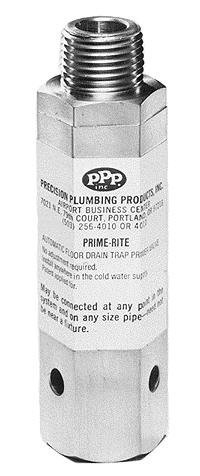
Start with the PPP PR-500.
It needs a minimum 3 PSIG pressure drop and no adjustment after installation. [5]
A trap primer adds water to a floor drain trap so the seal can’t dry out and let sewer gas in. The 2024 IPC and IRC require protection on emergency floor drains and traps that can evaporate; the UPC requires a primer on rarely used floor drains. Which method fits depends on your code and piping; the options are below.
Reference (not linked): PPP P1-500. Shown for comparison only. The linked picks are the PPP PR-500, the Zurn Z1021WL-PC and RectorSeal SureSeal 97044.
Product photo: Amazon.
For a fixture pressure drop

Product photo: Amazon.
For a lavatory or drinking fountain

Product photo: Amazon.
For odor and bug problems
Three are linked and one PPP valve is shown for reference. Specs come from PPP, Zurn and RectorSeal; listings from IAPMO and ASSE.
| Pick | Key specs | Pick it if | Skip it if |
|---|---|---|---|
| PPP PR-500 Prime-Rite | 20 to 80 psi working range, 3 psi drop to fire, 80 psi max, ½ in. NPT, 1 or 2 drains, 693 brass | You need one or two drains primed from a line where fixtures make only a small pressure dip, and you’d rather skip the adjusting screw. | You’re feeding three or four drains. The P1-500 covers that. |
| Zurn Z1021WL-PC | 1½ in. trap, 1½ in. OD p-bend outlet (WL), Reducer for 1¼ in. tailpiece, Braided primer hose, ½ in. FIP compression ends, Polished chrome | You’re under the IPC and there’s an emergency floor drain, trench drain or floor sink in the same room as a lavatory or hand sink. | The job is under the IRC or UPC, or the sink is in another room. Use a primer valve instead. |
| RectorSeal SureSeal 97044 | 4 in. drain outlet, Fits 3½ and 4 in. strainers, 4.34 in. across the gasket, Memory hinge, Pressure relief valve, AF-GW marking | You’re under the IPC or IRC and need to protect a floor drain where running a water line would mean opening a wall or slab. | The job is under the UPC, or it’s a Georgia plenum room. IAPMO lists SureSeal as not UPC compliant, and Georgia wants a primer there. Use a primer valve. |
From IPC 1002.4 and 1002.4.1.1 and PPP’s install sheets. Not to scale.
PPP’s sheets set the layout for both of its valves. Put the valve on a ½ to 1½ in. cold line that feeds a flush valve or another valve that opens often. Keep the valve at least 12 in. above the finished floor, run the makeup line no more than 20 ft, and slope it all the way to the drain.
PPP adds a rule of thumb for long runs: 1 ft of height for every 20 ft of distance.
The connection at the drain is the code’s part. The makeup water has to enter above the trap seal on the inlet side, so it refills the seal instead of running out the far side. Zurn’s literature calls this the floor drain’s trap primer connection.
My floor drain guide and hub drain guide cover the drain bodies.
Both PPP valves sense a drop in line pressure. Here are their numbers from PPP’s sheets.
When a fixture on the same line opens, the pressure at the valve dips. PPP’s P1-500 needs a 10 psi dip to fire and the PR-500 needs 3 psi. Each time it fires, the valve sends a metered shot of water down the makeup line to the trap.
Both valves work on 20 to 80 psi lines and take cold water only. PPP says not to put either one on a water heater line, because the pressure drop there is too small. That 20 to 80 psi band is the operating range for both. PPP also says never to expose the P1-500 to more than 125 psi; that is a pressure limit, not a range it primes in. The PR-500 tops out at 80.
If you don’t know your static pressure, my water pressure gauge guide covers how to read it.
Each pick keeps a trap wet a different way, so your code and piping decide, not a score.
The P1-500 is Precision Plumbing Products’ pressure-drop primer, from Portland, Oregon. Reference (not linked): shown for comparison only.
PPP’s submittal says it primes 1 to 4 floor drains with the company’s DU-U distribution unit, and the chart lists the DU-4 too. One valve can serve a whole row of drains in a restroom or mechanical room, as long as each one is reachable inside PPP’s 20 ft run.
It fires on a 10 psi drop across the valve and works on 20 to 80 psi lines. The install sheet says never to put it above 125 psi. That leaves room above its 80 psi working range.
Setting it is short. PPP says to turn the adjusting screw counterclockwise until water flows steadily, then clockwise until the dripping just stops. That sets it to your line pressure. Then cycle it at least five times to make sure it works.
The install rules are specific. Use ribbon tape only, don’t put more than 55 ft-lb on it, and don’t wrench on the hex. Install it plumb (vertical), as PPP’s instructions require, with a shutoff on the inlet and a union on the outlet, and add a debris loop so grit doesn’t go straight in.
One rule catches people at rough-in: PPP says not to put the valve through the rough-in pressure test. Plan to install it after testing, or isolate it.
It’s made of C693 lead-free brass with EPDM O-rings and a stainless mesh screen, and it’s marked lead free to NSF/ANSI 372-2024. IAPMO’s listing, current on Oct 21, 2026, covers the cP1-500 to ASSE 1018-2023 and CSA B125.3. PPP’s limited warranty replaces a defective valve for 3 years after installation; it excludes valves that are modified, improperly installed or degraded by water chemistry.
The PR-500 is PPP’s Prime-Rite valve. Reference (not linked): shown for comparison only.
Its big difference is the trigger. PPP’s submittal says it needs only a 3 psi drop across the valve, against 10 psi for the P1-500. A fixture that barely moves the pressure can still fire it.
It also needs no adjustment. PPP says so on the submittal and the install sheet, and the sheet’s only setup step is to cycle it at least five times after installing.
PPP lists a minimum discharge of 0.15 mL per activation at 20 psi and 0.05 mL at 80 psi. That’s a small shot each time, and PPP’s sheet puts the valve on a line feeding a flush valve or another valve that’s used often.
The limits are tighter than the P1-500’s. It primes up to 2 floor drains, with PPP’s DU-U or DU-4 for the second one. And the install sheet says never above 80 psi, which is also the top of its working range.
The install rules match the P1-500: ½ to 1½ in. cold line, valve plumb, shutoff on the inlet, union on the outlet, ribbon tape only, no more than 55 ft-lb. Keep it off water heater lines and out of the rough-in pressure test.
It’s 693 brass with EPDM O-rings and a stainless mesh screen, marked lead free to NSF/ANSI 372-2024. IAPMO’s file 0865 lists the cPR-500 (Prime-Rite) to ASSE 1018-2023, and PPP’s 3-year warranty applies.
The Z1021 is Zurn’s water saver trap primer, and the -WL-PC version is the chrome model with a one-piece waste elbow for a slip-joint wall connection.
It’s a sink trap with a second job. Zurn says that when a lavatory or drinking fountain drains, the water briefly backs up in the trap. That head of water overflows through a side connection and runs by gravity to the floor drain’s primer tapping.
So it primes with the sink’s own wastewater, with no supply line and no valve. Zurn lists no moving parts and a very low repair rate, and says it avoids the need for access doors.
The parts list on Zurn’s spec sheet: chrome-plated polished cast brass body with cleanout, ground joint elbow, 1½ in. slip nuts and washers, a reducing washer for a 1¼ in. sink tailpiece, escutcheons, and a stainless braided primer hose with ½ in. FIP compression fittings.
The code fit is narrow, and it matters. This is the IPC’s fixture drain method, 1002.4.1.5: a lavatory or hand sink may prime a floor drain, trench drain or floor sink in the same room. The line can’t run on or above the floor.
Zurn’s sheets claim no ASSE standard, and IAPMO’s directory showed no trap primer listing for the Z1021. That’s fine under 1002.4.1.5, which names none. It’s a problem under the UPC, which wants ASSE 1044 or IAPMO PS 76 for drainage-type primers.
It also only works when the sink gets used. A hand sink in a busy restroom is a good match; a sink nobody touches won’t keep the floor drain wet.
My call: in an IPC building with a hand sink beside the floor drain, it’s the cleanest answer on this page, because there’s nothing to adjust and no valve to service.
SureSeal is RectorSeal’s waterless inline drain trap seal, and item 97044 is the 4 in. size. The listing names model SS4009; RectorSeal’s page for 97044 calls it SS4009V.
It doesn’t add water. RectorSeal says it sits in the outlet of the drain body and forms a physical barrier that blocks sewer gas and odors, while a side hinge opens to let water through. A pressure relief valve keeps it from air-locking.
That’s a barrier-type device under IPC 1002.4.1.4 and IRC P3201.2.1.4, which require ASSE 1072. RectorSeal posts an ASSE seal renewal dated Nov 22, 2024: ASSE 1072-2020, seal 1409, covering the 4 in. SureSeal V and SS4009Plus.
IAPMO’s certificate C-4165 lists the same models to ASSE 1072-2020, effective August 2024. It’s a classified listing, and it says plainly that the products are not in compliance with the Uniform Plumbing Code. In a UPC area, this isn’t your answer.
Georgia has one more catch. Its 2026 amendment bans floor drains in air-handling rooms used as plenums, except a deep-seal drain with a trap primer on a water pipe. A barrier device doesn’t meet that exception.
Installing the 4 in. size is quick. Squeeze the fins at the three-line marks, push it through the strainer throat, and seat it level 4½ to 5½ in. below the grate. RectorSeal says it fits cast iron or plastic floor drains.
RectorSeal lists shower, outdoor, basement, HVAC, water heater and maintenance-area floor drains as uses. Other sizes cover 2, 3 and 3½ in. drains, so measure first. RectorSeal sells 97044 by the case of 6.
My call: in an IPC or IRC house with a basement floor drain far from any water line, it’s the simple fix. Under the UPC, skip it.
From the makers’ sheets and the IAPMO and ASSE listings. Scroll sideways on a phone.
| Pick | Type | Code method | Listed to | Needs | Key limit | Sold by | Buy |
|---|---|---|---|---|---|---|---|
| PPP PR-500 | Pressure-drop valve | IPC 1002.4.1.1, IRC P3201.2.1.1, UPC 1007 | ASSE 1018-2023 (IAPMO) | Cold line, 3 psi drop | 2 drains, 80 psi max | Plumber’s Paradise | Check it on Amazon |
| Zurn Z1021WL-PC | Lavatory drain primer | IPC 1002.4.1.5 only | None claimed | Lavatory in the same room | Not IRC or UPC | Amazon.com | Check it on Amazon |
| RectorSeal SureSeal 97044 | Barrier device | IPC 1002.4.1.4, IRC P3201.2.1.4 | ASSE 1072-2020 (ASSE, IAPMO) | Nothing | Not UPC compliant | Amazon.com | Check it on Amazon |
The PR-500 is the only pick that works under all three codes. The Zurn and the SureSeal are simpler, but each depends on your code: the Zurn on the IPC, the SureSeal on the IPC or IRC.
Read on codes.iccsafe.org and IAPMO’s UPC viewer, Oct 21, 2026. Your local code and inspector have the last word.
| Question | 2024 IPC | 2024 IRC | 2024 UPC |
|---|---|---|---|
| Which drains? | Emergency floor drains and any trap seal subject to evaporation (1002.4.1) | Emergency floor drains and traps subject to evaporation (P3201.2.1) | Floor drains or similar traps subject to infrequent use (1007.1) |
| What’s required? | Protection by one of 5 methods | Protection by one of 4 methods | A trap seal primer |
| Can the inspector waive it? | No waiver in the section | No waiver in the section | Yes, if not needed for safety or sanitation |
| Waterless barrier allowed? | Yes, ASSE 1072 (1002.4.1.4) | Yes, ASSE 1072 (P3201.2.1.4) | Not listed in 1007 |
| Lavatory drain as the primer? | Yes, same room (1002.4.1.5) | Not one of the IRC methods | Needs ASSE 1044 or IAPMO PS 76 |
| Primer must be accessible? | Not stated in 1002.4.1 | Not stated in P3201.2.1 | Yes, for maintenance (1007.1) |
The IPC defines an emergency floor drain as one that takes no discharge from any drain or indirect waste pipe and is there for spills, overflows and leaks. That’s the drain that sits dry for months, so its trap water evaporates. The code’s answer is to protect the seal, and a primer valve is only one of the ways.
The UPC words it differently. It asks whether a floor drain is used rarely, then requires a primer unless the inspector decides one isn’t needed for safety or sanitation.
The trap seal itself is the water standing in the bend, 2 to 4 in. deep under all three codes. Zurn’s literature explains why it matters: when that water evaporates, sewer gas and odors can come up through the drain. If you already smell it, my sewer smell guide covers the other causes.
My trap size by fixture chart covers sizing the trap itself.
The IPC’s list, matched to the IRC and UPC, with the standard each method has to meet.
| Method | IPC 2024 | Standard | IRC 2024 | UPC 2024 | Pick on this page |
|---|---|---|---|---|---|
| Primer valve on drinking water | 1002.4.1.1 | ASSE 1018 | P3201.2.1.1 | 1007.2, ASSE 1018 | PPP PR-500 |
| Primer valve on reclaimed or graywater | 1002.4.1.2 | ASSE 1018 | P3201.2.1.2 | Not named in 1007 | None |
| Primer device fed by wastewater | 1002.4.1.3 | ASSE 1044 | P3201.2.1.3 | 1007.2, ASSE 1044 or IAPMO PS 76 | None |
| Barrier device in the drain | 1002.4.1.4 | ASSE 1072 | P3201.2.1.4 | Not named in 1007 | RectorSeal SureSeal 97044 |
| Lavatory or drinking fountain drain | 1002.4.1.5 | None named | Not in the IRC | Not named in 1007 | Zurn Z1021WL-PC |
The first three rows add water. A primer valve takes it from a pressurized supply; a wastewater device takes it from a drain. The IPC and IRC give the same rule for all three: the primer’s discharge pipe connects to the trap above the seal, on the inlet side.
The barrier row adds no water at all. It’s a device in the drain that blocks evaporation, installed per its maker’s instructions.
The last row is IPC-only. A lavatory or hand sink drain may prime an emergency floor drain, trench drain or floor sink in the same room, and a drinking fountain drain may prime one in the same or the next room. The line can’t run on or above the floor.
The IRC has no such method, so a house under the IRC needs one of the other four.
Read on IAPMO’s product listing directory and the makers’ posted certificates, Oct 21, 2026.
| Pick | Standard | Who lists it | Listing | What to check on the part |
|---|---|---|---|---|
| PPP PR-500 | ASSE 1018-2023, CSA B125.3-2022 | IAPMO R&T | File 0865 (cPR-500 Prime-Rite) | Name, model, psi range, cUPC mark |
| Zurn Z1021WL-PC | None claimed | None found | No trap primer listing in IAPMO’s directory | Zurn name and model |
| RectorSeal SureSeal | ASSE 1072-2020 | ASSE; IAPMO R&T | ASSE seal 1409; IAPMO C-4165 | AF-GW and the C/IAPMO mark |
IAPMO’s PPP listing spells out what the standard asks of a primer valve. It must include a way to stop back-siphonage, and its water and makeup connections can’t be smaller than ½ in. NPT. That’s the ASSE 1018 the codes name for drinking-water primers.
PPP’s own sheets show the UPC mark and the lead-free mark but don’t print the ASSE number, so the IAPMO listing is the document to show an inspector.
For SureSeal, IAPMO lists the AF-GW marking, which the part should carry, and RectorSeal says markings are molded into the part. If the inspector asks, that’s what to point at.
The Zurn has no listing to show, and under IPC 1002.4.1.5 it doesn’t need one.
From PPP’s P1-500 and PR-500 install sheets. Your code’s rules come first.
| Step | Do this | Why, per PPP |
|---|---|---|
| 1. Pick the line | ½ to 1½ in. cold line that feeds a flush valve or a valve used often | The valve fires on the pressure drop that fixture makes |
| 2. Flush the line | Run water through before installing | Keeps debris out of the valve |
| 3. Set the height | Valve at least 12 in. above the finished floor, installed plumb | PPP’s minimum elevation |
| 4. Seal the threads | Ribbon tape only; 55 ft-lb max; don’t wrench on the hex | Over-tightening can damage the valve and void the warranty |
| 5. Add service parts | Shutoff on the inlet, union on the outlet, debris loop | Lets you service it; keeps grit out |
| 6. Run the makeup line | To the trap inlet, up to 20 ft, sloped all the way | Water has to reach the trap by gravity |
| 7. Skip the rough-in test | Install after the pressure test or keep it isolated | PPP: don’t put the valve through it |
| 8. Set and cycle | P1-500: set the screw. Both: cycle at least 5 times | Confirms it fires |
Two steps deserve extra care. PPP ties firing to the pressure drop of the fixture on that line, so step 1 decides whether the valve works at all. And PPP says plainly not to put the valve through the rough-in pressure test.
My backflow preventer guide covers the other devices you’ll meet on the same supply lines.
What each type needs and which standard the codes tie it to.
Needs a cold supply line and a fixture that makes a pressure dip. ASSE 1018 under all three codes.
Needs a sink or fountain drain in the same room. IPC 1002.4.1.5 only.
Needs nothing but the right size. ASSE 1072 under the IPC and IRC.
Needs a drain to feed it. ASSE 1044 under the IPC and IRC; ASSE 1044 or IAPMO PS 76 under the UPC.
Needs a power supply. The UPC ties electronic types to ASSE 1044 or IAPMO PS 76.
Needs water that meets the valve maker’s quality limits. ASSE 1018 under the IPC and IRC.
On this page, the valves cover the most jobs because they work under every code. Electronic primers show up in catalogs from makers like PPP and J.R. Smith, but I didn’t read a maker sheet for one this round, so none is picked here.
Whichever type you choose, match it to the standard your code names before you buy.
Georgia DCA, State Amendments to the 2024 IPC, revised Jan 1, 2026.
| Section | What Georgia’s amendment says | Effect on primers |
|---|---|---|
| Adoption | 2024 IPC with Georgia amendments, effective Jan 1, 2026 | The IPC rules on this page apply |
| 1002.4 and 1002.4.1.1–.5 | Not amended | All five methods stand |
| 401.4 (new) | No floor drains in a room with air-handling equipment used as a plenum, except a deep-seal drain (4 in. min seal) with a trap primer on a water distribution pipe | Plenum rooms need a primer valve, not a barrier or lavatory primer |
| 1304.3.2 (new) | Reclaimed water from an EPD-permitted facility may supply trap primers for floor drains and floor sinks in hotels, motels, apartments, condos, and commercial, industrial and institutional buildings | A reclaimed-water primer valve is an option |
The plenum rule is the one to remember. If a mechanical room’s air handler uses the room as its return, Georgia allows a floor drain there only with a 4 in. deep seal and a trap primer on a water pipe. That rules out the SureSeal and the Zurn for that drain.
My condensate drain line guide covers the air handler’s own drain.
Four places the makers, listings and codes don’t line up, and what to go by.
| Topic | One source says | The other says | Go by |
|---|---|---|---|
| Barrier vs primer | RectorSeal: SureSeal eliminates the need for a trap primer | UPC 1007.1 requires a primer; IAPMO: not UPC compliant | Your code: fine under IPC and IRC, not UPC |
| Zurn’s listing | Zurn: no standard claimed | UPC 1007.2: drainage primers need ASSE 1044 or PS 76 | IPC 1002.4.1.5 only |
| PPP’s ASSE number | PPP sheets: UPC and lead-free marks only | IAPMO file 0865: ASSE 1018-2023 | The IAPMO listing |
| SureSeal model name | Amazon: SS4009; RectorSeal page: SS4009V | Certificates: 4 in. SureSeal V and SS4009Plus | RectorSeal’s 97044 page and the AF-GW mark |
The first row is the big one. RectorSeal’s literature says SureSeal gives trap seal protection equal to a water-based primer, and the IPC and IRC agree by listing barrier devices. The UPC doesn’t list them, and IAPMO’s own certificate says so.
If you’re not sure which code your town uses, call the building department before you buy.
Use the adopted code family confirmed by the building department. These are candidate routes for a plumber to check, not code approval. Pressure inputs are optional when you don’t have measurements.
Choose the code family and site details to see candidate routes.
Check listing marks, line slope, backflow protection and local amendments against the adopted code. Check your measurements against the maker’s guide.
| Question | If yes | If no |
|---|---|---|
| Is the job under the UPC? | A primer valve: the PR-500 | Any of the three may fit |
| Is there a cold line with a busy flush valve nearby? | PR-500 for 1 or 2 drains | Zurn or SureSeal |
| Do fixtures on that line make only a small pressure dip? | PR-500 (3 psi) | PR-500 (fires at 3 psi, so it covers this too) |
| IPC, with a lavatory or hand sink in the same room? | Zurn Z1021WL-PC | A valve or SureSeal |
| IPC or IRC, no water line within reach? | SureSeal, sized to the drain | A primer valve |
| Georgia plenum room? | Primer valve on a water pipe, 4 in. deep-seal drain | Any method your code allows |
For most commercial jobs, the answer is the PR-500 on the supply to a flush valve, with PPP’s distribution unit if you’re feeding more than one drain. For a house basement drain under the IRC, the SureSeal is the easy fix, and it skips the water line.
My trench drain guide and trap arm length chart cover the rest of the drain layout.
It adds water to a floor drain trap so the water seal doesn’t evaporate. Zurn’s literature explains why that matters: a dry trap lets sewer gas and odors come up through the drain.
No. The 2024 IPC and IRC require trap seal protection on emergency floor drains and traps subject to evaporation, and a primer is one of several allowed methods. The UPC requires a primer on floor drains used rarely, unless the inspector decides it isn’t needed.
Under the IPC and IRC, a barrier-type device listed to ASSE 1072, like RectorSeal’s SureSeal. The IPC also lets a lavatory, hand sink or drinking fountain drain prime a nearby floor drain. The UPC lists neither.
Where your code requires trap seal protection: emergency floor drains and seals subject to evaporation under the IPC and IRC, and rarely used floor drains under the UPC. Georgia also requires one for a deep-seal drain in an air-handling plenum room.
A pressure-drop valve senses the dip in line pressure when a nearby fixture opens, then sends a metered shot of water to the trap. PPP’s P1-500 fires on a 10 psi drop and the PR-500 on 3 psi.
No. Waterless trap seals are barrier devices that block evaporation without adding water. The IPC and IRC allow them if they’re listed to ASSE 1072; a primer adds water and falls under ASSE 1018 or 1044.
Not PPP’s valves. PPP says both the P1-500 and PR-500 connect to cold water only and not to a water heater line, because the pressure drop there is too small.
PPP recommends a makeup line no longer than 20 ft, sloped all the way to the drain, with the valve at least 12 in. above the floor. It also suggests 1 ft of height for every 20 ft of run.
Above the trap seal, on the inlet side of the trap. The 2024 IPC and IRC both say so for primer valves and wastewater-fed primers.
At least 2 in. and no more than 4 in. under the 2024 IPC, IRC and UPC. The IPC allows deeper seals for some accessible fixtures, and the UPC where the inspector finds it necessary.
Under the UPC, yes: 1007.1 says trap seal primers must be accessible for maintenance. Zurn says its Z1021, with no moving parts, avoids the need for access doors.
It depends on the valve. PPP says the P1-500 primes 1 to 4 floor drains with its DU-U distribution unit, and the PR-500 primes up to 2 with a DU-U or DU-4.
I’ve used these picks.
I compared three models using maker manuals and spec sheets. The code lookup keeps water primers, fixture-drain priming and barriers separate.
The PPP P1-500 has no buy link for now. Amazon’s listing shows the P1-500 name with a P2-500 part number.
PPP’s sheet says the P2-500 primes 1 to 2 floor drains, while the P1-500 primes 1 to 4. [4]
I checked CPSC recall records for Precision Plumbing Products, Zurn and RectorSeal on November 10, 2026 and found no recalls. [10] [11] [12]